Almost everything written about shading a South African home is written from somewhere specific, and then quietly applied everywhere. That fails badly in this province, because the Western Cape is not one climate wearing one name — it is three, and they behave nothing like each other. A specification that is exactly right for a flat on the Atlantic seaboard will cook a farmhouse in the Breede Valley and rot on a deck in Knysna. This guide is the honest version: what all of us share, where the province splits, and what changes for you depending on which side of a mountain range you happen to live on.
Short on time? Grab the PDF and come back to it — 13 pages.
One name, three climates
The Western Cape is usually described as having three climatic zones — the Mediterranean zone, the South Coast zone and the Karoo zone.1 The Mediterranean part, which covers Cape Town, the Peninsula, the West Coast and the Winelands, has warm dry summers and cool wet winters. The South Coast, running east through the Overberg to the Garden Route, is an all-year rainfall area and among the wettest parts of the country. The Karoo portion in the north of the province is semi-arid: hot summers, cold winters, roughly 400 mm of rain a year and that mostly in summer, with winters almost completely dry.1
Those are not shades of the same thing. They pull window design in opposite directions. In one, the enemy is glare off cold bright water. In the next, it is stored heat in a valley with no sea breeze to shift it. In the third, it is damp that never fully leaves the air. And in the fourth corner of the map it is a twenty-degree drop between four in the afternoon and four in the morning.
So this guide is arranged the way the province is arranged: west to east, coast to interior. Find yourself on it before you read anyone's product recommendation, including ours.
The part every house here does share: the sun
Weather divides us. Geometry does not. Published sun-path data for Cape Town gives a midwinter noon sun of about 31 degrees above the horizon, setting on a bearing near 295 degrees, and a midsummer noon sun of about 75 degrees, setting near 240.2 The province spans roughly three and a half degrees of latitude between the Olifants River and Cape Agulhas, so those figures shift by a couple of degrees as you travel — not nearly enough to change what follows.
Three things fall out of them, and they are true in Vredendal, in Robertson and in Plettenberg Bay alike:
The summer sun sets south of west. A bearing of 240 degrees is west-south-west. That is why so many people are baffled that the hottest room in the house is not the one they call "the west room" — it is the corner that runs round toward south-west, and it takes the beam nearly horizontally through the last three hours of the day.
The winter sun is low, northerly and worth keeping. At 31 degrees it reaches deep into a north-facing room, and in July that is free heat. Blacking out a north elevation to solve a January problem is the most expensive mistake in this whole subject.
A high summer sun is easy to stop; a low one is not. At 75 degrees, an ordinary eave or overhang above a north window does most of the work for you. At 15 degrees on a west wall at seven in the evening, nothing above the window helps at all — the answer has to stand in front of the glass.
If you take one practical instruction from this whole guide, take this one: go and stand in the room that annoys you, at the hour it annoys you, in the season it annoys you, and watch where the light actually lands. Everything else is negotiation.
Zone one
The cold-water coast
The Atlantic seaboard, the West Coast and much of the Peninsula sit against water cooled by the Benguela current, which flows north up the western side of southern Africa and keeps the sea here strikingly cold for the latitude.3 That single fact produces a very particular window problem, and it is not the one people expect.
Cold sea keeps coastal air moderate, so the ambient temperature is often pleasant. But the water is a huge, bright, moving reflector, and on a clear afternoon the glare bouncing up off it is fierce — it arrives from below the eaves, at an angle no overhang was ever designed to intercept. Add the south-easter, which blows mainly from October to March, is most persistent in November and December, and strengthens through the afternoon as the land heats,4 and add salt, and you have the coastal brief in one paragraph.
What we'd fit on the cold-water coast
Sunscreen mesh rollers on the view glass, in a pale colour. The whole point of buying here is what is outside the window, so the fabric that keeps the view while dropping the glare is nearly always the right first move.
A blockout layer behind it in bedrooms — mesh and blockout on one double bracket gives you a daytime answer and a night answer at the same opening.
Wind-rated exterior hardware, without exception. Awnings, screens and external blinds all carry an operating wind class; ask for it in writing, and treat a motorised wind sensor as part of the specification rather than an extra.
Told straight: salt does not negotiate. Powder-coated aluminium, corrosion-rated fixings and sealed cassettes are the minimum here, and a fresh-water rinse of exterior hardware two or three times a year does more for its life than anything you can buy. See Cape Town Metro & Peninsula for how we handle the apartment stock specifically.
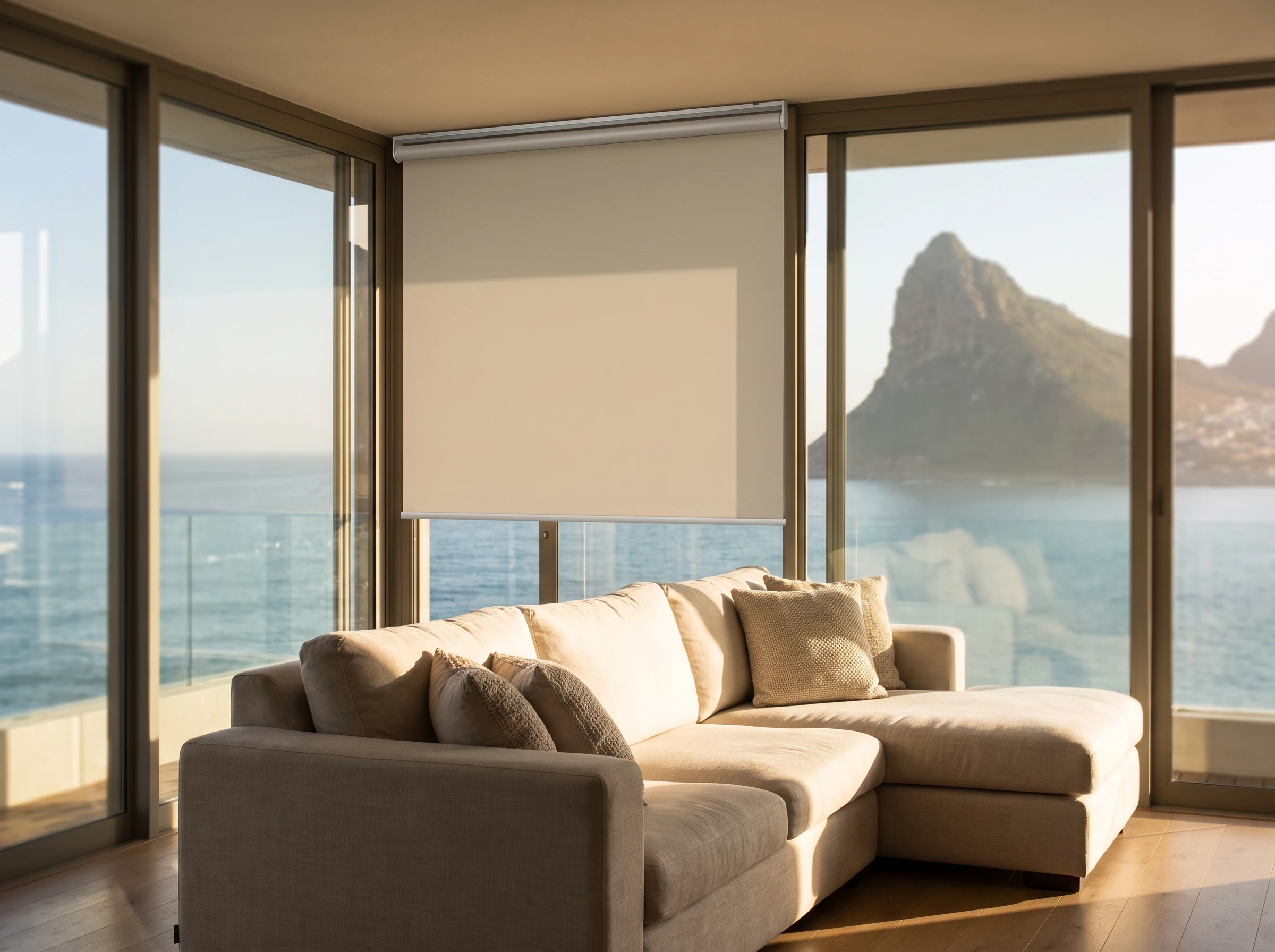
Down over the pane that is taking the beam, up on the two that are not — on this coast a mesh is a glare tool, not a curtain.Zone two
Over the passes, into the heat
Cross Sir Lowry's or Du Toitskloof and the sea stops helping you. The Winelands valleys, the Breede Valley and the Little Karoo run genuinely hot in summer, and the air sits still in a way it never does on the coast. Everything the guide said about a west-south-west beam gets worse here, because there is no cool onshore drift arriving at five o'clock to take the edge off it.
The building stock splits sharply too. On an old werf you get thick masonry walls with small, deep-set windows — a design that was itself a shading strategy, and one that mostly still works. On a new estate a few kilometres away you get frameless glazing from floor to ceiling, handed over with nothing on it at all. Same valley, same sun, opposite briefs.
One thing to know before you plan anything on a heritage property: under the National Heritage Resources Act, altering a structure — or part of one — older than sixty years needs a permit from the provincial heritage authority.5 An interior blind is a furnishing decision. A bracket into an old facade is not.
What we'd fit in the hot valleys
External shading on the west and south-west glass, first. This is the zone where it pays for itself fastest, because the heat gain is the whole problem and an interior fabric can only respond to it after it has already arrived.
Timber or aluminium venetians on smaller deep-set windows, where a tilt is worth more than a lift: you steer the light off the ceiling and keep the room readable. Aluminium in kitchens and bathrooms, timber where it stays dry.
A retractable awning over the stoep, wind-sensored. The wind that matters inland is not the summer south-easter — the berg wind is a hot, dry, downslope wind off the interior, most active outside midsummer, and it is the one that finds a badly set awning.
The fade warning nobody gives you: hard inland sun is unkind to fabric and to everything behind it. Where a room has a floor, a piano or artwork you care about, the shading conversation should start outside the glass, not at the swatch book. More on the region: Cape Winelands.
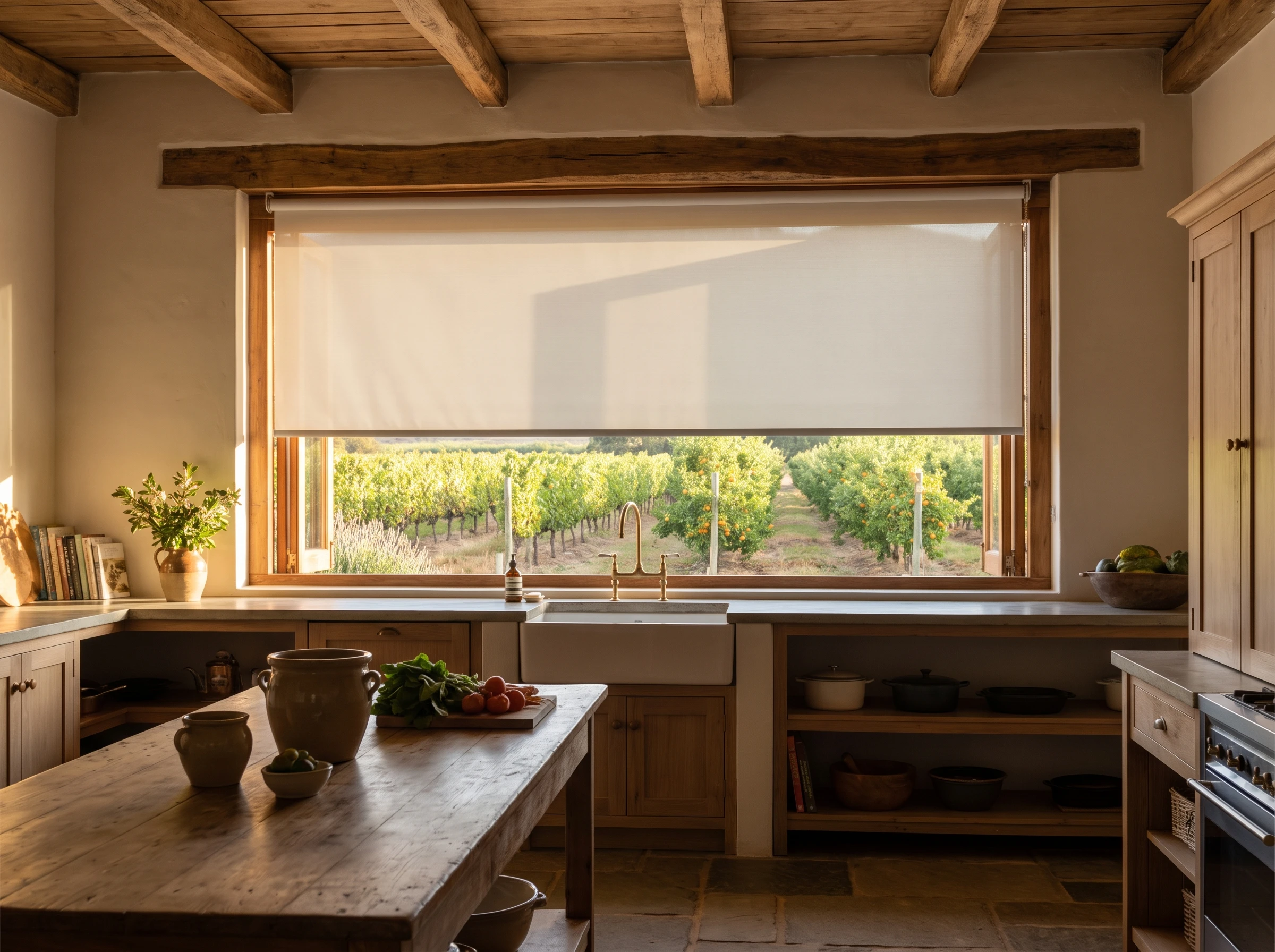
Two-thirds down over a valley kitchen window: the beam is off the counter, and the orchard is still there under the hem.Zone three
The coast where it rains in every month
Travel east and the rainfall regime changes underneath you. The Overberg coast and the Garden Route are an all-year rainfall area — one of the richest rainfall regions in the country, where you can expect some rain in any month rather than a wet season and a dry one.1 The sea alongside is warmer than the Atlantic side, the air is more humid, and mist is a normal part of the week.
That flips the priorities completely. Here the questions are not really about heat. They are about what happens to a product that is damp for weeks at a time.
What we'd fit on the wet coast
Anything outside must close and dry. A folding-arm awning that winds fully into a sealed cassette will outlive one that lives permanently open, by years. This is not an upsell; it is the difference between a product and a repair bill.
Zip screens on the deck, because a covered deck facing a lagoon or an estuary is the room people actually live in, and a tensioned mesh in side channels turns it into one on a wet, blowing afternoon without walling it off.
Wipeable fabrics and aluminium, not timber, in the damp rooms. Real timber slats are lovely and they are wrong above a shower, a scullery sink or a kitchen hob in this climate. They bow, the tapes mark, and it does not come back.
The unglamorous advice that matters most: mould grows where still moisture sits on a cool surface. Leave a blind a little air behind it, lift it on dry days, and open a window for a few minutes twice a day. No fabric on earth substitutes for that. See Garden Route and Helderberg & Overberg Coast.
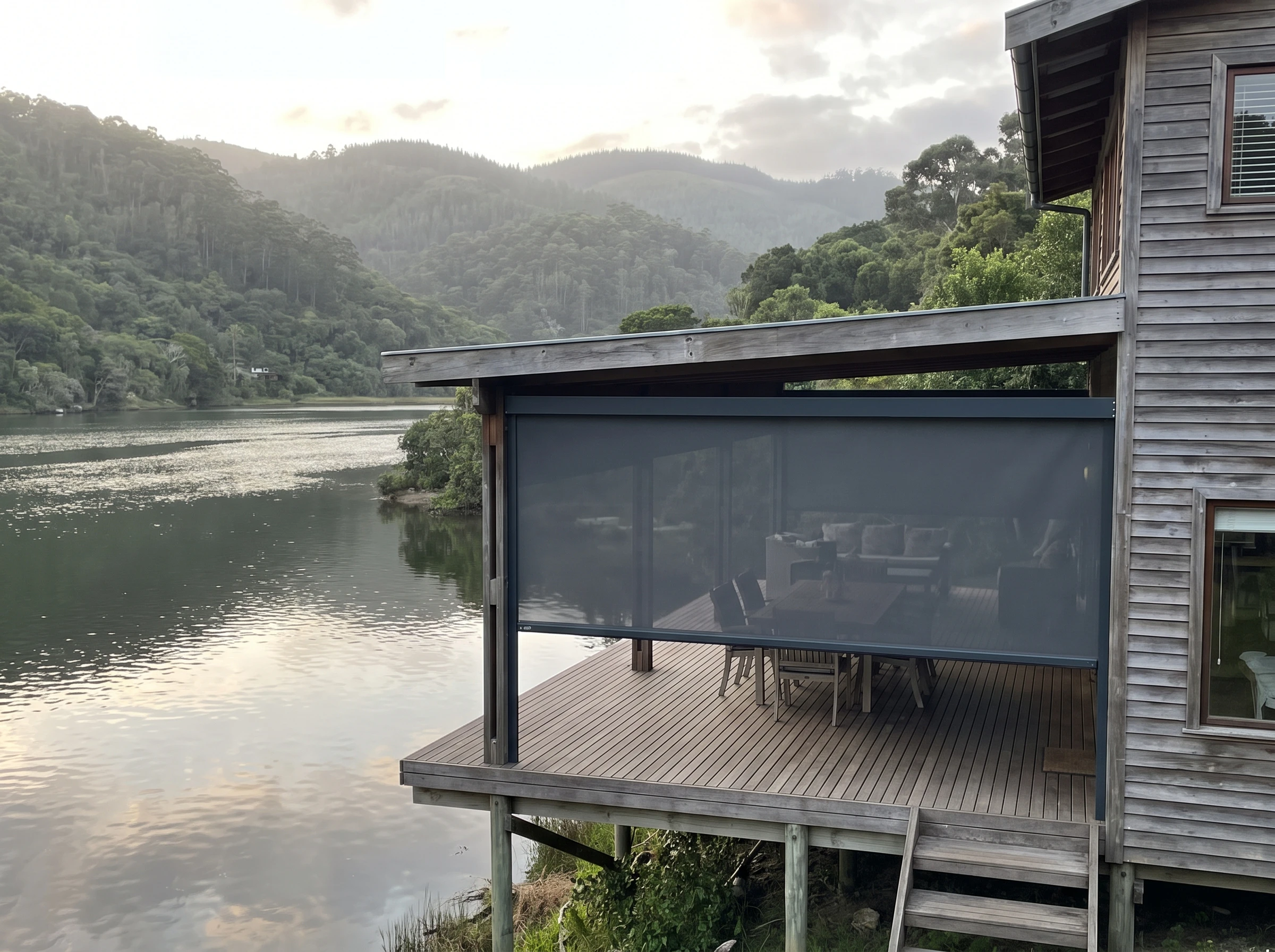
A tensioned mesh closing the open side of a lagoon deck — shelter on a damp, still morning, and it rolls away when the weather turns kind.Zone four
The dry interior, and its swing
The Karoo portion of the province is the one most often left out of shading advice altogether, and it is the one where the standard advice is most wrong. It is semi-arid — hot summers, cold winters, little rain and almost none of it in winter.1 The number that matters is not the daytime maximum. It is the gap between the afternoon and the small hours.
A window here has two opposite jobs in the same twenty-four hours: keep a savage sun out at three in the afternoon, and keep the room's warmth in at three in the morning. Very few window products do both. One does it better than the rest.
What we'd fit in the dry interior
Cellular honeycomb blinds, and this is the zone that justifies them most. The fabric is built from cells that hold a layer of still air against the glass; the still air is the insulator, and it works in both directions — resisting heat coming in during the day and holding warmth in at night.
External shading on the sun-struck elevations, for the same reason as the hot valleys, only more so. Stopping the beam at the wall is worth more than any interior fabric where the sun is this direct.
Dust, not salt, is the maintenance story here. Fine grit blown into the side channel of a screen or the guide of an external blind is what eventually stops it. Keep the channels clear, and the hardware will outlast the fabric.
The one rule that holds everywhere
For all the differences above, one principle survives the whole drive from Lambert's Bay to Nature's Valley: on an elevation that takes direct low sun, shade belongs on the outside of the glass.
The reason is not commercial. Sunlight passes through a pane easily; once it has landed on something inside and become heat, it does not pass back out nearly as easily. A blind behind the glass is intercepting energy that is already in the room — it protects your floor and your eyes and it does not stop the room warming. Stop the beam before the pane and there is nothing to trap.
The premium answer, wherever you are in the province
External venetian blinds — aluminium slats outside the glass that raise and tilt, so you deflect the beam and keep the view under it, then raise them clear in winter to take the low north sun you actually want. Our external venetian blinds page has the detail.
Roller shutters where a room wants full shade, an insulating air gap and a real drop in outside noise. Plainly: these are shading shutters — sun, heat, glare and privacy — not a security-rated product, and we would rather say so than let you assume otherwise.
Zip screens where the space to shade is a patio, stoep or deck rather than a window, and the mesh needs to hold against wind rather than hang in it.
The catch, in every zone: all three fix to the outside of your building. That means a proper structural fixing, a higher price than any interior product, a heritage or estate conversation where one applies, and hardware specified for whatever your local air does — salt on one coast, damp on the other, dust inland. Where external genuinely is not possible, a sunscreen roller inside the glass is the honest second best; cheaper, and weaker on heat.
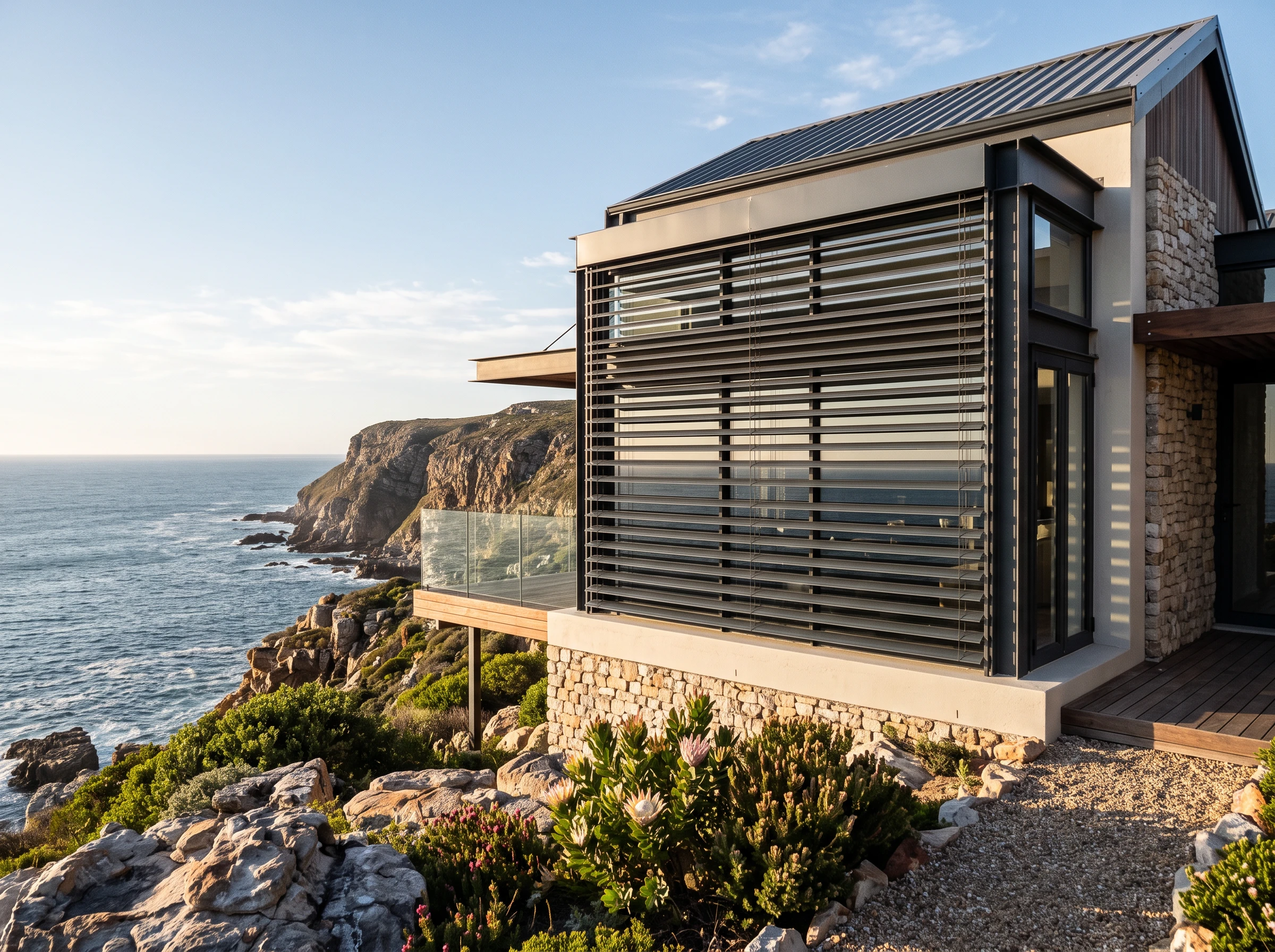
Mounted proud of the glass on the seaward elevation: the pane behind these slats never gets the chance to warm up.
What a measure settles that a guide never will
A provincial guide can only take you to the edge of your own street. These five come off the house itself:
Which zone you are actually in. Boundaries on a climate map are smudges, not lines. Somerset West behaves differently from Stellenbosch twenty minutes away; a Franschhoek valley floor is not a Franschhoek slope. Your own street's behaviour beats any regional label.
What is in the way. A neighbour's gable, a mountain shoulder, a stand of gums, a north-facing eave that is deeper than it looks — all of them shade windows for free, and all of them change what you should buy.
What the wall is behind the plaster. Old solid masonry, cavity brick, hollow block or lightweight framing take completely different fixings, and one of them may rule an external product out on that particular elevation.
Who else has a say. A heritage permit, an estate architectural committee, a body corporate. That is a conversation to have before the order, not after the delivery.
Where the power is. Motorisation is the right answer on wide, high or hard-to-reach glass, and only workable if there is a supply within reach or a battery tube you can actually get to.
Which is exactly why the measure is free and unhurried. Each of those is far cheaper to discover before a quote than after a fitting.
Tell us where in the province the house is and which room is the problem. One of our expert consultants will contact you shortly to arrange a free in-home measure, with fabric and slat samples in hand and a written per-window quote afterwards.
No obligation, no call-centre — a consultant calls you directly
Specified for your zone, not for a generic Cape address
Written, itemised quote before anything is ordered
Sources
Checking our working
Every climate figure and legal statement above traces to one of these. The reading of what they mean for a particular wall, and every product recommendation, is our own opinion, offered free and without obligation.
SA-Venues — Western Cape climate and weather (the province's three climatic zones — Mediterranean, South Coast and Karoo; warm dry summers and cool wet winters in the Mediterranean zone; an all-year rainfall South Coast among the country's richest rainfall regions; a semi-arid Karoo zone with hot summers, cold winters and roughly 400 mm a year falling mainly in summer).
Gaisma — Cape Town sun path data (June-solstice altitude at 12:00 about 31° with a sunset bearing near 295°; December-solstice altitude at 12:00 about 75° with a sunset bearing near 240°). Solar-noon angles on this page are calculated (90 − the gap between latitude and declination, ±23.44°); the source's figures above are 12:00 readings.
Wikipedia — Benguela Current (the cold current flowing northward along the west coast of southern Africa, and the reason Atlantic-side sea temperatures here stay low for the latitude).
Wikipedia — Cape Doctor (the south-easterly blows mainly in late spring and summer, roughly October to March, is most persistent in November and December, and strengthens in the afternoon).
SAFLII — National Heritage Resources Act 25 of 1999, section 34 (a permit from the provincial heritage resources authority is required to alter or demolish any structure, or part of a structure, older than 60 years).
Nothing on this page is a heritage-approval opinion, an energy assessment or a damp survey. Those belong to Heritage Western Cape, your local municipality and a suitably qualified professional respectively.