Home / Products / Roller Blinds
A fabric, a tube, and a spec that changes at every address
The roller blind is the simplest product we make. It's also the one where the Western Cape's four regions pull hardest in different directions — the fabric decision belongs to the room, the hardware decision belongs to the address, and this page walks through both.
First decision: what must the fabric do at 3pm?
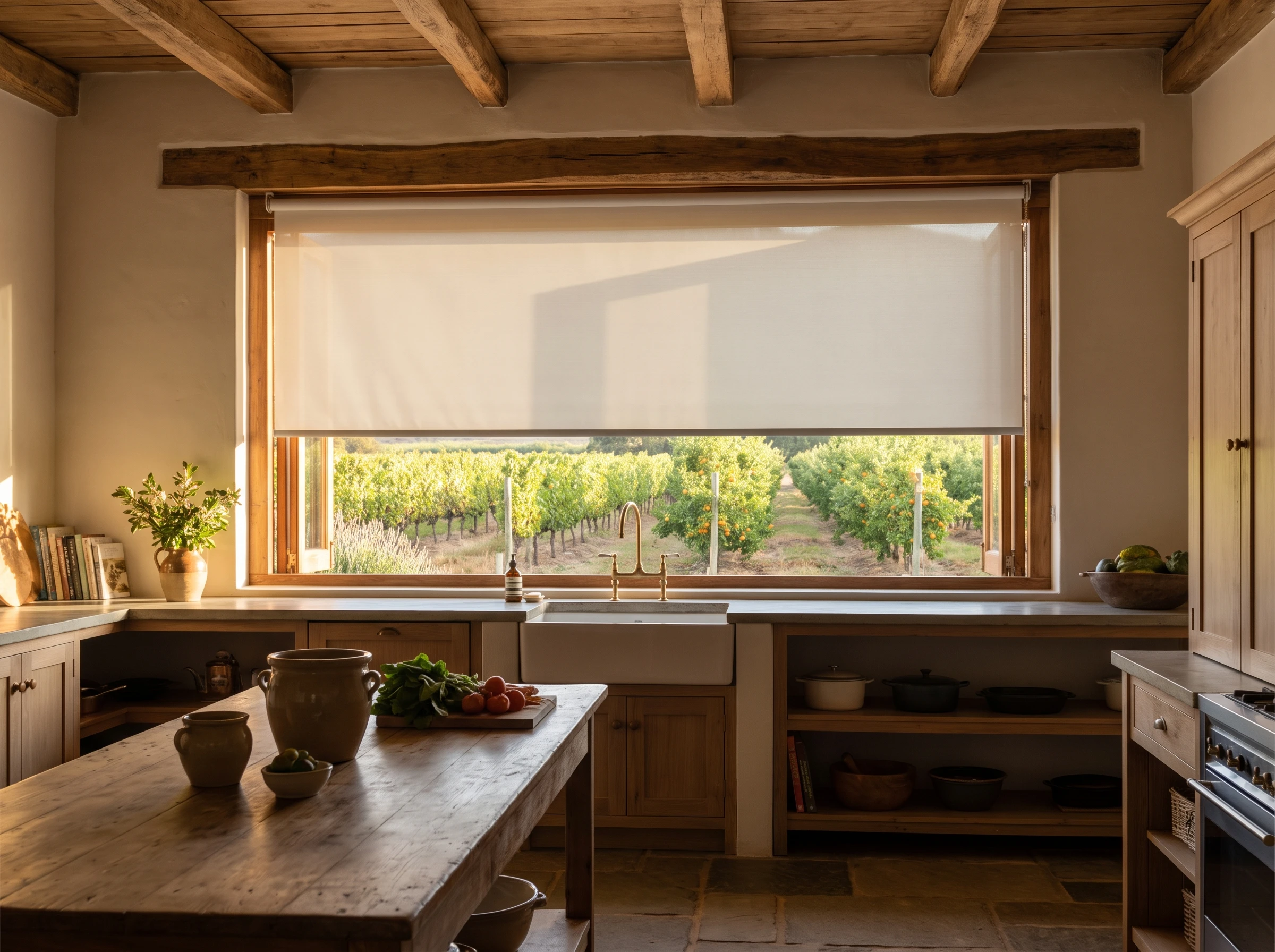
Start in the room, not the catalogue. A bedroom wants dark — a single flat blockout sheet, sized to the reveal, does that job and nothing else. A living room built around a view wants the opposite: a woven sunscreen mesh open enough to hold the ocean, the vineyard or the fairway in the frame while it takes the sting out of the glare and stops the UV that fades a rug one shade per summer. And a room that needs both — the main bedroom with the lagoon view is the classic Garden Route example — gets a double roller, two fabrics on one bracket, so the hour decides which one is down.
That's the whole fabric conversation. Three options, one question: what should this window be doing in the middle of the afternoon?
Second decision: what will your address do to the hardware?
This is where the province stops being one place. The tube, brackets, chain and fixings on an identical fabric get specified four different ways depending on which region the window sits in — and the consultant confirms which case applies at the free measure, not after installation.
Cape Town Metro & Peninsula
Anything within reach of salt spray gets powder-coated or stainless componentry, and on sectional-title stock we check what the body corporate allows before quoting — even an interior roller can be visible from the street on a glass facade. More on the Metro & Peninsula.
Cape Winelands
Inland heat is the enemy here, not salt — so the priority shifts to UV-stable fabrics and, on werf buildings with gables older than 60 years, a fixing method that respects the Section 34 heritage process. More on the Winelands.
Helderberg & Overberg Coast
Golf-estate aesthetic committees often regulate what shows through the glass from outside — fabric colour included — so we confirm the estate's rules before fabric is ordered, not after. More on the Helderberg & Overberg.
Garden Route
The province's wettest air calls for moisture-tolerant tubes and finishes as the default, and holiday homes that stand empty for weeks often justify motorised rollers on a timer. More on the Garden Route.
Two identical bedrooms, one in Sea Point and one in Franschhoek, would leave our workshop with the same fabric and different everything else.
Roller blind specification, Western CapeThird decision: how it moves
Chain control is the default, always with a child-safe tensioner anchored to the wall. Spring assist earns its place on wide, heavy fabrics you'd rather nudge than crank. Motorisation stops being a luxury the moment a window sits above a staircase, behind a kitchen counter, or in a holiday house that should look lived-in while it isn't — and on stacked glass, one remote running five rollers to the same height beats five chains that never quite line up. Very wide openings are the honest exception: past roughly three metres of fabric, one blind becomes two linked blinds or a motorised pair, because an oversized single roller telescopes and tracks skew.
Roller blind questions, region by region
Which sunscreen openness works for a west-facing sea view?
Tighter than you'd guess. West-facing Atlantic glass takes the full force of late-afternoon sun off the water, so we usually land on a denser weave there than on an east-facing vineyard window — and we'll show you both weaves against your own glass at the measure rather than argue percentages on paper.
Can the two fabrics on a double roller be different colours?
Yes — and they usually are. A common Cape pairing is a dark sunscreen (better view clarity through the mesh) with a light blockout that keeps the room from feeling like a cave when it's drawn. The two fabrics roll independently, so there's no need for them to match.
Will a roller blind alone keep a Winelands room cool in February?
Honestly, no. An interior fabric intercepts heat after it's already through the glass. It helps — but on a hard west or north elevation in valley heat, the real fix is stopping the sun outside, with an external venetian or shutter, and letting the interior roller handle glare and privacy. We'd rather tell you that at the measure than sell you a blind that disappoints in summer.
Does the Cape Doctor or the Berg wind matter for an interior roller?
Only when the window is open — then it matters a lot. A flapping bottom bar on a south-easter afternoon will mark a sill and eventually itself. Where a room is ventilated through blinds that stay down, we spec side guides or a heavier bar, and that call depends on whether your address faces the summer south-easter or the hot Berg wind out of the interior.
Roller blind pricing across the province
Per square metre installed, a hand-chained roller, blockout, sunscreen or translucent weave alike, comes to about R1,000 to R1,600 per square metre. A basic blockout takes the low end; a fine sunscreen weave; a low-openness sunscreen, or a two-cloth pairing on a single bracket, sits at the upper. Motorised, allow R2,500 to R3,800 per square metre for the tube motor, the control and the commissioning.
These are guide bands rather than a quotation, and they hold across the province. A floor price applies to narrow windows, since the hardware and the labour do not shrink with the glass. Each window is costed one at a time after the measure and set down in writing.
Three decisions, one visit
Fabric, hardware, control — settled at a free in-home measure, priced per window, in writing.