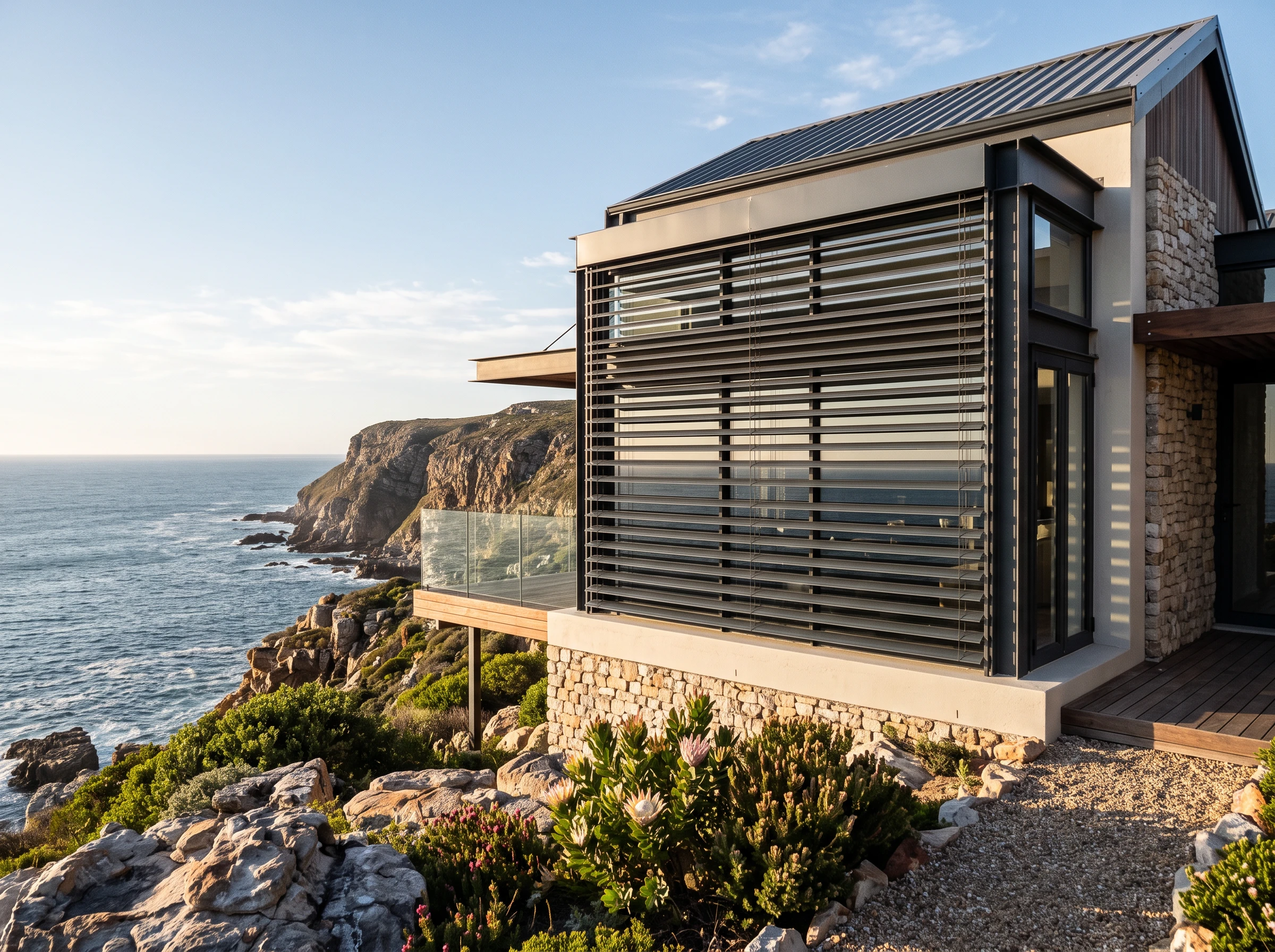
Why outside beats inside, physically
An interior blind manages heat that's already inside the room. An exterior blind stops most of it at the glass, before it ever becomes the room's problem. On a hard west or north elevation — an Atlantic Seaboard apartment's floor-to-ceiling glass wall as much as a Winelands farmhouse window — the difference in how a room feels by four o'clock is dramatic. It's the same logic European and high-end South African architects have used on glass buildings for decades, applied to a Western Cape window.
Built for the outside, wherever the outside happens to be
Wide 60-90mm aluminium slats run in guided side rails, tilt and raise, and are essentially always motorised with wind-sensor auto-retract — an exterior product has to protect itself in a gust the way an interior blind never needs to. What changes by region is the coating spec and the wind rating underneath: marine-grade fixings on anything within salt-spray reach of the coast, a heavier wind rating on a ridge-top or clifftop stand, and — on a heritage gable or an estate facade — sign-off confirmed before the bracket goes anywhere near the wall.
The aircon fighting a west-facing glass wall is fighting heat that's already won — external shading stops the fight before it starts.
On-site measure, Western Cape- Wide 60-90mm aluminium slats, guided side rails, tilt and raise
- Motorised as standard, with wind-sensor auto-retract
- Marine-grade coatings specified wherever salt spray actually reaches
- Heritage or estate-committee sign-off confirmed before quoting
- Premium building-improvement spend, not window dressing
External venetian pricing across the province
Anything mounted outside the glass is a different class of product: R3,000 to R4,500 per square metre installed crank-operated, and R4,500 to R6,500 per square metre motorised with sun and wind sensing. Guided side rails, heavier blade profiles and higher wind ratings all sit at the upper end, and on an exposed coastal or mountain elevation those are the specification rather than the extras.
The fixing substrate is checked on site before anything is quoted, because an exterior blind puts real load into the wall it hangs on. These are guide bands rather than a quotation, and they hold across the province. A floor price applies to narrow windows, since the hardware and the labour do not shrink with the glass. Each window is costed one at a time after the measure and set down in writing.
A glass wall the aircon can't keep up with?
A free measure at the address, then a written quotation itemised for each window. No obligation.